Indonesia runs two mining economies at once. One is the industrial sector the market tracks — nickel for batteries, coal for export, copper and gold from a handful of very large pits. The other is small-scale and locally worked, licensed under a different instrument, and, by design, closed to the capital a foreign investor brings.
The implementing regulation for mineral and coal mining does not use the phrase "artisanal and small-scale mining." The international shorthand has no direct counterpart in the text. What the regulation provides instead is a small-scale licence — the *Izin Pertambangan Rakyat* (IPR), literally a people's mining licence — a separate simplified permit for rock, the *Surat Izin Penambangan Batuan* (SIPB), and the industrial licence that carries the sector, the *Izin Usaha Pertambangan* (IUP).
Three instruments, three sets of eligible holders, three different sets of ground rules. This article reads the provisions that separate them, and sets that against what the U.S. Geological Survey records about where Indonesia's small-scale mining actually shows up in the national output.
Everything below is drawn from Government Regulation No. 96 of 2021, as amended by Government Regulation No. 25 of 2024, read in the official Indonesian text on the Ministry of Energy and Mineral Resources' legal database, and from the USGS Minerals Yearbook 2023 chapter on Indonesia. Indonesian provisions are translated here; the translation is Teramine's.
The three routes side by side
| Industrial — IUP | Small-scale — IPR | Rock — SIPB | |
|---|---|---|---|
| Who may hold it | a business entity — state, regional or private, and "private" expressly includes a company established in the framework of foreign investment — a cooperative, or a sole proprietorship | an individual who is a local resident, or a cooperative whose members are local residents | a regional or village-owned enterprise, a private company established in the framework of domestic investment, a cooperative, or a sole proprietorship |
| What must come first | the mining area (WIUP) must be obtained (Art. 9(5)) | the area must already be designated a people's mining area, or WPR (Art. 62(2)) | the area must already be designated a mining business area, or WUP (Art. 129(2)) |
| Duration | — | up to 10 years, extendable twice for five years each (Art. 64) | up to three years, extendable twice for three years each, for rock of a specified type; the project contract's term, for a specified purpose (Art. 133) |
| Explosives | — | prohibited (Art. 66) | prohibited (Art. 131(4)) |
| Underground work | — | prohibited for individual holders (Art. 66) | — |
A dash means the provision was not read for this article; nothing has been inferred to fill the cell.
The small-scale licence: who may hold an IPR
Article 62 answers the eligibility question in a line. An IPR is granted by the Minister on application by either an individual who is a local resident or a cooperative whose members are local residents.
Two features follow at once. First, an application may only be filed in an area that has already been designated a people's mining area (WPR) — defined in the regulation as the part of a mining area (WP) where small-scale mining is carried out. The licence does not create the ground; the designation comes first. A single WPR may host one or several IPRs, but each applicant may hold no more than one.
Second, the qualifying test is not capital or technical capacity but residence. The applicant must produce a certificate from the local kelurahan or desa confirming that the applicant — or, in a cooperative's case, the whole of its management — are local residents, alongside a business identification number, an identity card, a statement of willingness to comply with environmental protection and mining-safety law, and a tax clearance certificate (Art. 63).
The term is capped: a maximum of 10 years, extendable twice for five years each (Art. 64). The obligations are operational. A holder must begin mining within three months of the licence being issued, and must first prepare a mining plan on the basis of the WPR management document drawn up by the Minister — a plan that has to state the mining method, the equipment used, the work schedule, the personnel required, and the cost or capital (Art. 65). The regulation also caps what the work may involve: no explosives, no prohibited hazardous or toxic materials, no underground mining by an individual holder, and adherence to good mining practice with particular attention to environment and safety (Art. 66). The detailed procedure sits in a ministerial regulation (Art. 67).
It is worth being exact about what this licence is, and is not. The IPR is the *licensed* small-scale route. It is not the only small-scale mining that happens.
The rock route: SIPB
A second simplified permit covers construction minerals rather than ore. The SIPB is granted by the Minister, and its list of eligible applicants is at once narrower and wider than the IPR's: a regional-owned or village-owned enterprise, a private company established in the framework of domestic investment, a cooperative, or a sole proprietorship (Art. 129(1)). Foreign investment does not appear in that list, and the Minister separately fixes the business scale a domestic-investment private company must have to qualify (Art. 130).
Like the IPR, it cannot create its own ground: an application may only be made in an area already designated a WUP (Art. 129(2)). The permit is for a specified type of rock or a specified purpose (Art. 129(3)), and the regulation lists the rocks it covers — among them fill soil, hill and river gravel, river stone, screened river gravel, sand for fill and for masonry, natural gravelly sand, soil, sea sand, laterite, clay and limestone (Art. 129(4)). Its stages run from planning through mining and processing to hauling and selling (Art. 129(6)).
The documentation is lighter than an IUP's but not absent: administrative, technical, environmental and financial requirements, where the technical requirement is a statement that explosives will not be used and the financial requirement is the last year's audited accounts, plus the coordinates and the area applied for (Art. 131). The holder may begin mining once the Minister has approved a mining plan (Art. 132). The term for a specified rock type is up to three years, extendable twice for three years each; for a specified purpose, the permit runs with the government or regional construction project it serves (Art. 133).
The industrial route, and the line that separates them
The industrial licence — the IUP — is the route that admits foreign capital. Under Article 9 it is granted by the Minister on application by a business entity, a cooperative, or a sole proprietorship; the business entity may be state-owned, regional-owned or private, and a private business entity expressly includes one established in the framework of foreign investment. The applicant must have obtained a WIUP, its mining area, first (Art. 9(5)).
Set side by side, the three articles mark a boundary. Foreign investment is admissible in the industrial licence; it is absent from both simplified routes — the IPR reserves the small-scale licence to resident individuals and their cooperatives, and the SIPB admits domestic entities only. The simplified routes are also bounded in ways the industrial route is not: each is anchored to an area the state must have designated first, whether a WPR or a WUP; each is capped in time; and each carries a limit on how the work may be done.
Where small-scale mining shows up in the data
The USGS yearbook chapter on Indonesia is a useful check on how much of this sits inside the licensed system and how much does not. It records Indonesia in 2023 as the world's first-ranked producer of nickel ore, at 54% of global production; the second-ranked producer of mined tin, at about 23%; and the third-ranked producer of coal, at 9%. Mining and quarrying accounted for about 11% of GDP in 2023, and the sector employed about 1.66 million people — 1.2% of national employment.
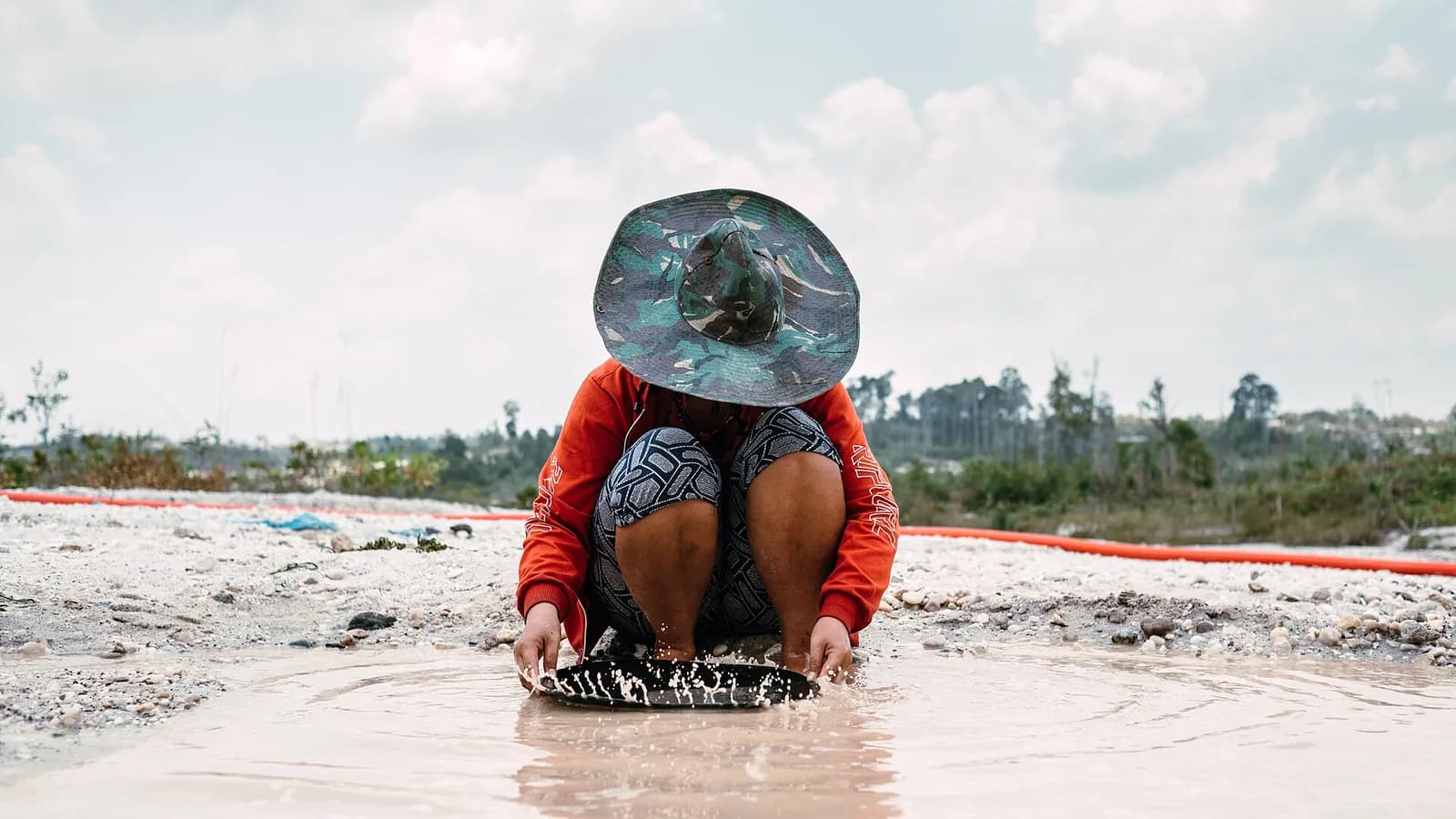
Tin is where the small-scale sector becomes visible in the national tables. In the yearbook's list of the country's mineral-industry facilities, the entry for tin ore carries two operators: the state-controlled PT Timah, and, on its own line, artisanal miners, with mines in the Bangka Belitung Islands and no capacity figure recorded. That the statistical profile of a major commodity lists artisanal production as a separate operator is the clearest official acknowledgement that it is part of the picture, even where it is not quantified.
The same chapter shows the friction between the two worlds. PT Timah, the world's fifth-ranked tin refiner, produced about 14,900 tonnes of mined tin and 15,340 tonnes of refined tin in 2023 — falls of 26% and 23% on 2022 — and the USGS attributes the decline in part to what it calls "pervasive unauthorized mining activities" inside the company's own onshore mining sites, alongside adverse weather and deeper offshore reserves.
That is the practical shape of the divide. The licensed small-scale route is bounded, residential and short-term. The mining that surrounds it is not always licensed at all.
What this means for an investor
- The small-scale licence is not an entry point for foreign equity. The IPR is restricted to local individuals and their cooperatives; the SIPB names domestic entities only. A foreign investor's vehicle is the IUP, with the exploration, approval and divestment machinery that route carries.
- The two sectors share ground, so they share risk. An IUP can sit beside, or come under pressure from, unlicensed small-scale workings — USGS records exactly that at PT Timah's onshore sites. For a producing asset, the overlap is an operating and community-relations variable, not a footnote.
- "Designated first" cuts both ways. Neither the IPR nor the SIPB can exist until the state has set the area aside as a WPR or a WUP. Where a WPR has been gazetted, the state has decided that small-scale mining belongs in that district; that decision is a signal about how the surrounding tenure is being planned.
- The size of the workforce is the size of the stake. Mining and quarrying employs about 1.66 million people in Indonesia. A licence regime that reserves part of that work to residents is a regime built to hold a social licence, not only to allocate mineral rights.
Catatan Teramine
This section is Teramine's editorial assessment. It is not a fact reported by the regulation or the USGS, and it is not legal advice.
Read together, the three licences are one design. Indonesia does not exclude small-scale mining; it channels it. The residence test is the load-bearing wall — it decides who may hold the small-scale licence before a single technical question is asked — and the requirement that a WPR or a WUP be designated first means the state decides where that channel runs before an application exists. The caps on term and on method keep the small-scale route from scaling into an industrial one by drift.
For a foreign investor the design has a clear consequence. The question is not whether small-scale mining is present near a target asset — it usually is, in some form — but whether it sits inside the licensed channel or outside it. Licensed, adjacent small-scale workings are a planning fact a WPR map will show. Unlicensed ones are the risk the USGS records at PT Timah: production loss, security cost, and a community you share the ground with whether or not you hold the permit.
We handle the permit work behind an industrial licence — IUP and IUPK applications, RKAB, and the operating documents a project must hold — through [mining permit services](/en/layanan-izin). Indonesian mining opportunities offered for take over, joint venture and joint operation are listed on the [mining marketplace](/en/marketplace), each with its commodity, location and scheme stated.
Related reading on this site: [IUP vs IUPK](/en/news/iup-vs-iupk) for how the two industrial licences differ; [Foreign Ownership in Indonesian Mining](/en/news/foreign-ownership-indonesian-mining) for the divestment clock that runs with a foreign-held IUP; and [Mining Joint Venture in Indonesia](/en/news/mining-joint-venture-indonesia) for the structures that move a licence or a company.
Sources
Both documents below were read in full text for this article. Indonesian provisions are translated into English here; the translation is Teramine's, and where a figure appears above it is the figure printed in the source.
- U.S. Geological Survey, 2023 Minerals Yearbook — The Mineral Industry of Indonesia (advance release), by Jaewon Chung, U.S. Department of the Interior / U.S. Geological Survey, published June 2025. Used for: Indonesia's 2023 world rankings and shares of production (first in nickel ore at 54% of global production, second in mined tin at about 23%, third in coal at 9%); the mining and quarrying sector's approximately 11% share of GDP in 2023; employment of about 1.66 million people, or 1.2% of total employment, in mining and quarrying in 2023 (citing Badan Pusat Statistik); the listing of "artisanal miners" as a tin-ore operation in the Bangka Belitung Islands in Table 2 (Structure of the Mineral Industry); PT Timah's 2023 output of about 14,900 t of mined tin and 15,340 t of refined tin, and the reported declines of 26% and 23%; and the reference to "pervasive unauthorized mining activities" at PT Timah's onshore mining sites. Read in full text on 1 October 2026.
- Government Regulation of the Republic of Indonesia No. 96 of 2021 on the Implementation of Mineral and Coal Mining Business Activities (Lembaran Negara RI Tahun 2021 No. 208), official salinan published by the Ministry of Energy and Mineral Resources' legal database, JDIH ESDM. Used for: Article 9 (who may hold an IUP — a business entity, a cooperative or a sole proprietorship, with private business entities including those established in the framework of foreign investment — and the requirement to obtain a WIUP first); the definitions of the IPR as a licence to carry out mining business in a people's mining area with limited area and investment, and of the WPR as the part of a WP where small-scale mining is carried out; Article 62 (IPR granted by the Minister on application by a local-resident individual or a cooperative of local residents; applications only in an already-designated WPR; one or several IPRs per WPR; a maximum of one IPR per applicant); Article 63 (the documentary and residence-certificate requirements for individuals and cooperatives); Article 64 (a term of up to 10 years plus two five-year extensions); Article 65 (the three-month start requirement, the WPR management document and the required contents of the mining plan, and ministerial guidance); Article 66 (the technical requirements — no explosives, no prohibited hazardous and toxic materials, no underground mining by individual holders, and good mining practice with attention to environment and safety); Article 67 (further regulation by ministerial regulation); Article 129 (SIPB eligibility, the WUP precondition, specified rock types or purposes, the list of covered rock commodities, and the permit's stages); Article 130 (ministerial determination of the qualifying business scale for domestic-investment private entities); Article 131 (administrative, technical, environmental and financial requirements, including the no-explosives statement and the one-year audited accounts); Article 132 (mining after the Minister approves the mining plan); and Article 133 (SIPB terms for specified rock types and specified purposes). Read 1 October 2026.
- Government Regulation of the Republic of Indonesia No. 25 of 2024 on the Amendment of Government Regulation No. 96 of 2021, JDIH Kementerian ESDM. Used to confirm the substance of the IPR and WPR definitions and that the provisions relied on above — Articles 62 to 67 on the IPR and Articles 129 to 133 on the SIPB — are not among those amended. The amendment list covers the definitions and Articles 22, 48, 54, 56, 79, the new Article 83A, and Articles 104, 109, 111, 120, 162, 177, 180, 183, 195A and 195B. Read 1 October 2026.