Indonesia's coal trade is being managed on three axes at once, and only one of them points up.
The value is up. Indonesian coal exports were worth US$18.11 billion in January–July 2026, a 8.36 percent increase year on year, on Trade Ministry data reported from the 31st Coaltrans Asia forum in Badung, Bali, on 28 September 2026. Total national exports over the same seven months were US$167.3 billion.
The tonnage is not. Shipments fell 23 percent in August 2026 against August 2025, and 6.54 percent against July, the lowest for any August in five years, on data reported by *The Jakarta Post* and carried by OilPrice.
And the channel is narrowing. Under Government Regulation No. 24 of 2026, PT Danantara Sumberdaya Indonesia (DSI) manages a single-door export mechanism that today covers three commodities — coal, palm oil and ferroalloys — and is scheduled to be fully in force by the end of December 2026.
This article is about the export side only: what leaves, what it is worth, where it appears to go, and what governs the movement. Production and the RKAB quota regime are treated separately in [Coal Mining in Indonesia](/en/news/coal-mining-in-indonesia).
Value up, tonnes down — read the two numbers together
| Measure | Period | Figure | Source |
|---|---|---|---|
| Coal export value | Jan–Jul 2026 | US$18.11 billion, +8.36% y/y | Trade Ministry, reported by ANTARA |
| National exports, all goods | Jan–Jul 2026 | US$167.3 billion, surplus ~US$3.9 billion | Trade Ministry, reported by ANTARA |
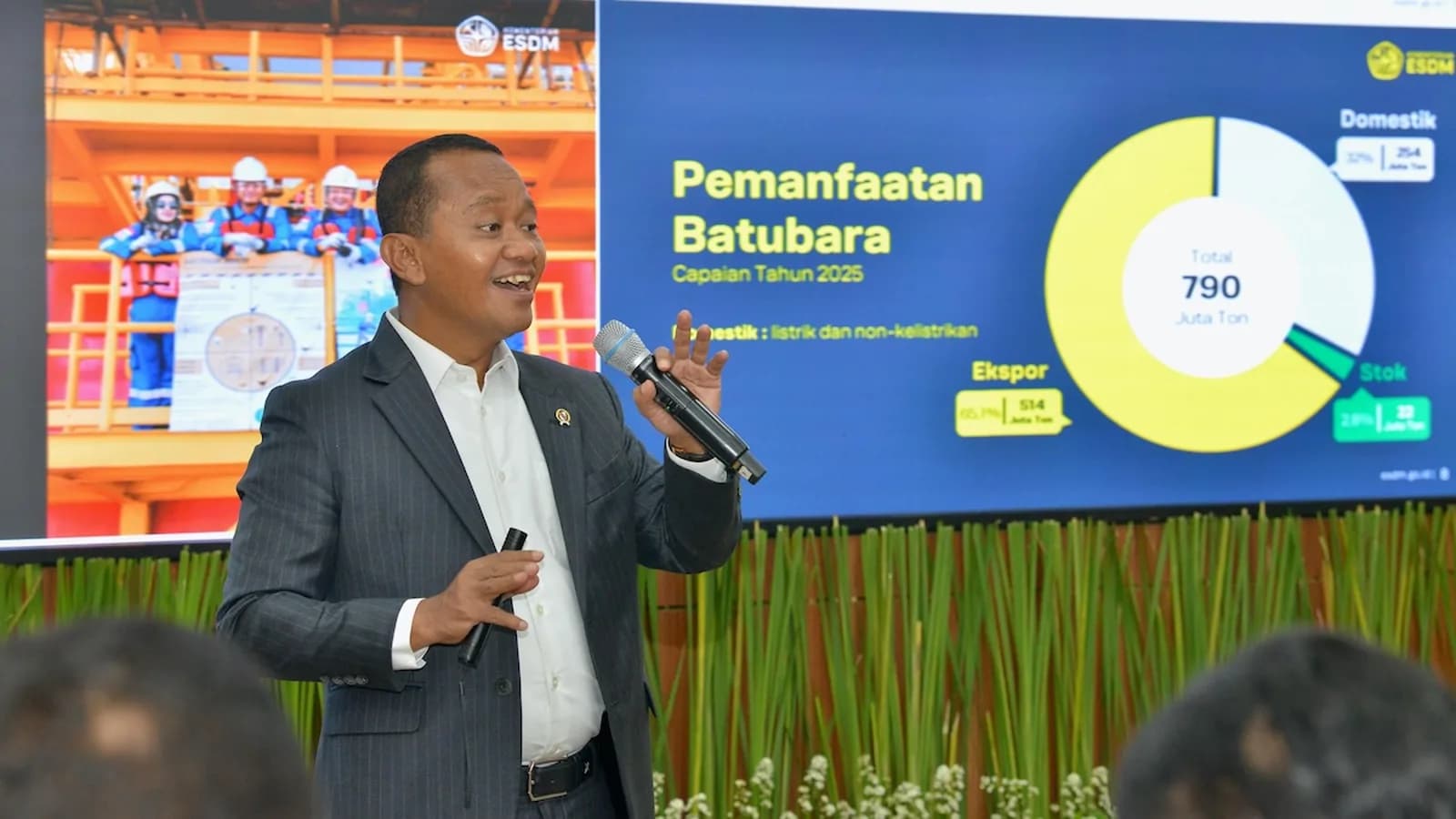
| National coal production | Jan–Jul 2026 | 423.71 million tonnes | ESDM, reported by ANTARA |
| — share allocated for export | Jan–Jul 2026 | 63.82% | ESDM, reported by ANTARA |
| National coal production | full-year 2025 | 817.48 million tonnes | ESDM, reported by ANTARA |
| — share allocated for export | full-year 2025 | 63.89% | ESDM, reported by ANTARA |
| Coal shipments | August 2026 | −23% y/y, −6.54% m/m | data reported by *The Jakarta Post*, via OilPrice |
Two distinctions matter in that table, and both are easy to get wrong.
The first is allocation versus shipment. ESDM reports what share of production is *allocated* to export; that is a plan approved under the RKAB, not a customs exit figure. The realised flow is what moved in August: a 23 percent year-on-year fall, the weakest August in five years.
The second is volume versus price. The Director General of Mineral and Coal, Tri Winarno, put the Coal Benchmark Price (HBA) for January–August 2026 at an average of about US$111.8 per tonne. Value rose while tonnes fell, which is what a higher price per tonne and a richer product mix look like in the same statistic — not evidence that demand increased.
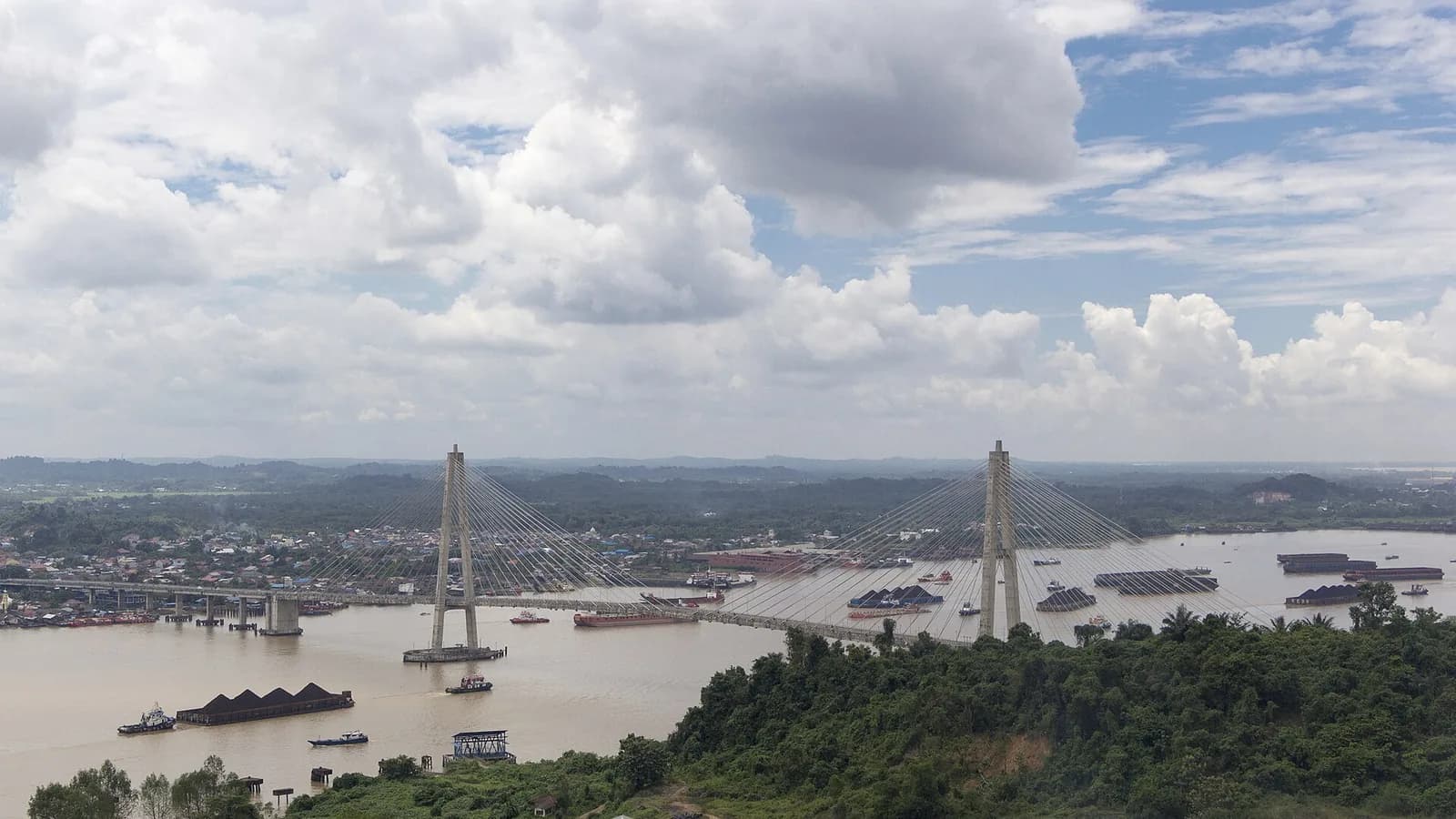
Three factors are cited for the squeeze on tonnes. ESDM points to quotas and to weather: the 2026 dry season is expected by the meteorological agency BMKG to run longer than normal, and lower rainfall can reduce the flow of the Barito and Mahakam rivers, the principal routes that move coal by barge to export ports. OilPrice records the same mechanism in market terms — lower river levels disrupting barge movements — and quotes a trader, Matthew Boyle of Ashon International DMCC, telling Bloomberg: *"Last year we did about 4 million tons of Indonesian coal sales; this year we'll be lucky to get 2 million."*
On the production side, the two published targets for 2026 do not agree. ESDM's own figure, as reported by ANTARA, is a national RKAB target of about 600 million tonnes. The International Energy Agency, in its Coal Mid-Year Update 2026, is reported by OilPrice as putting the figure at 641 Mt, with Indonesian output falling by more than 12 million tonnes, or 1.5 percent, from 2025. Both are reported figures; this article did not read the RKAB document itself.
Where the tonnes go
The destination list has been remarkably stable, and unusually concentrated.
ESDM's position as stated in September 2026 is that China and India remain the main markets for Indonesian coal exports, with India and the ASEAN region seen as the sources of demand growth — including into 2027 — while global coal demand over the next five years is expected to ease slightly as renewables take a larger share.
The historical detail behind that comes from the U.S. Geological Survey, which tracks the physical flows:
- 2021: 434 million tonnes exported.
- 2022: 466 million tonnes exported, of which 106 million tonnes was lignite — up despite a one-month export ban that began on 1 January 2022.
- On the 2022 flows, India was the leading recipient excluding lignite, followed by China; China took most of the lignite exports.
- The 2022 rise is attributed by USGS to higher global coal prices driven by supply disruption after the conflict in Ukraine began.
Scale, in trade terms: coal alone accounted for 16 percent of Indonesia's total goods exports in 2022 and 13 percent in 2023, when total goods exports were US$259 billion and mineral products were US$69 billion, or 27 percent of the total.
What is not stated here is a 2026 destination split in tonnes. No page read for this article reports one, so none is given.
The export channel is being centralised
The regulatory layer is where the direction of travel is clearest.
On 1 June 2026 the government launched its single-door export mechanism. Under PP No. 24 of 2026, PT Danantara Sumberdaya Indonesia was established to manage and oversee it. Trade Minister Budi Santoso said on 22 September 2026 that the transition runs to 31 December 2026, with full implementation at the end of that year. As of that date the mechanism covered coal, palm oil and ferroalloys.
The Coordinating Ministry for Economic Affairs puts numbers on the pilot: about 6,500 export declarations analysed in DSI's first three months, representing more than US$14 billion in trade value and more than 90 million tonnes, shipped to more than 100 destination countries. Those figures cover all three commodities, not coal alone.
Two further instruments sit on top. At Coaltrans Asia on 28 September, the Trade Ministry's Director of Industrial and Mining Product Exports, Muhammad Rivai Abbas, named Trade Ministry Regulation No. 15 of 2026 on coal export policy and the arrangement of coal resources, alongside Trade Ministry Regulation No. 12 of 2026 on simplifying export policy and licensing. His framing of the purpose:
"Going forward, Indonesia does not want to be known merely as a commodity exporter, but also as a reliable global energy partner that can ensure supply certainty and create greater economic value."
The Coaltrans Asia forum brought together around 3,500 participants from more than 10 countries. Two industry voices at it: the Indonesian Coal Mining Association's chairman, Priyadi, who said around 50 to 60 active producers among its more than 100 members are ready to plan long-term under the evolving framework — *"If the goal is better and more transparent governance, then industry players will also feel comfortable"* — and DSI's president director, Luke Thomas Mahoney, whose stated function is to act as an intermediary between exporters and buyers and to provide visibility into transactions.
What was read and what was not. The two Trade Ministry regulations are described here as reported by two independent outlets in English and Indonesian (ANTARA and Indonesia Business Post); the text of Permendag No. 15 of 2026 was not read for this article, and no clause, threshold, licence type, fee or effective date is stated that is not in those reports.
Timeline
| Date | What changed |
|---|---|
| 1 Jan 2022 | ESDM bans coal exports for one month to secure domestic power-plant supply |
| 2022 | Exports nevertheless rise to 466 Mt from 434 Mt in 2021; coal is 16% of total goods exports |
| 2023 | Coal is 13% of total goods exports; Indonesia is the third-ranked coal producer at 9% of world output |
| 1 Jun 2026 | The single-door export mechanism launches, initially covering coal, palm oil and ferroalloys |
| 22 Sep 2026 | Trade Minister confirms the transition runs to 31 Dec 2026, with full implementation then |
| 28 Sep 2026 | Trade Ministry names Permendag 15/2026 on coal exports and Permendag 12/2026 on licensing at Coaltrans Asia |
| Aug 2026 | Coal shipments −23% y/y, −6.54% m/m — the weakest August in five years |
| 31 Dec 2026 | End of the single-door transition period |
Dates to 2023 are recorded by the U.S. Geological Survey's Indonesia chapters; dates from 2026 are from ANTARA's reporting of ESDM and Trade Ministry statements and from OilPrice's reporting of *Jakarta Post* data. The most recent month covered by the sources read here is August 2026.
What this means for a buyer, a trader or an investor
- Read allocation as a ceiling, not as a shipment. ESDM reports the share of production allocated for export (63.82 percent for January–July 2026); the customs flow is the August figure, down 23 percent. Contracts that assume the allocation is what will sail are exposed to the gap.
- The counterparty structure is changing, not the commodity. With a single channel managed by DSI and transaction visibility stated as its purpose, the practical question for a foreign buyer is who is on the other side of the contract and what data about the transaction is now visible to the state.
- The binding constraint this year has been physical. Longer dry seasons lower the Barito and Mahakam, and barges cannot load on a shallow river. That is a logistics risk in a coal export exposure, and it is not managed by a permit.
- Destination concentration cuts both ways. China and India are stated by ESDM as the main markets, and India and ASEAN as the growth markets. There is no published 2026 tonnage split to price that against.
- Value growth is not volume growth. Coal export value rose 8.36 percent in January–July 2026 while the most recent month's shipments fell 23 percent. If you are underwriting a coal export position, the currency is dollars per tonne, not tonnes.
- Permit and reporting work is where the export regime now bites. RKAB preparation sits behind every export allocation — see [RKAB services](/en/layanan-izin/jasa-penyusunan-rkab-batubara) — and coal assets offered for sale are listed on the [marketplace](/en/marketplace).
What could not be sourced, and is therefore not stated
- Any 2026 coal export volume in tonnes, by destination or in total. Only the August percentage change (via *Jakarta Post* data reported by OilPrice) and the production-allocation shares (ESDM via ANTARA) were read.
- The text of Permendag No. 15 of 2026 and PP No. 24 of 2026. Both are described as reported by ANTARA and Indonesia Business Post; no article or annex of either was read.
- Realised export values for 2024 and 2025. The value figures here are January–July 2026 and the historical shares of total exports recorded by USGS.
- Any royalty, export duty, export levy or DMO percentage. None was read in the sources used.
- Which companies hold export allocations, and in what tonnage. Not reported in the sources read.
- A reconciled 2026 production target. ESDM's reported figure is about 600 Mt; the IEA's, as reported by OilPrice, is 641 Mt. This article states both and chooses neither.
- Whether the single-door mechanism changes the commercial terms of any existing contract. No source read describes the contractual mechanics.
Catatan Teramine
This section is Teramine's editorial assessment, not a statement of fact from ESDM, the Trade Ministry, DSI, USGS, the IEA or any outlet named above.
Read together, the numbers say something narrower than "Indonesia is restricting coal exports". They say the state has moved from taxing the coal trade to *routing* it. In 2022 the instrument was a one-month export ban, and exports rose that year anyway because the price made them irresistible. In 2026 the instruments are a production quota, an allocation share and a single export channel — and the trade is responding to the third of those in particular, because a channel is not a price signal. A buyer who has been sourcing Indonesian coal through an independent trader is not being shut out; the trader is being made visible. That is a different commercial risk, and it is worth pricing as a compliance cost rather than as scarcity.
The genuinely interesting number is the one nobody is publishing. Coal export value up 8.36 percent with August shipments down 23 percent is either a strong price year or a product-mix shift toward higher-rank coal, and the sources read here do not separate the two. For a buyer, the practical consequence is the same either way: this is a year in which Indonesian coal is scarce in tonnage and expensive in dollars, and the logistics that carry it — two rivers in Kalimantan — are the part of the supply chain a foreign investor can least influence and should model most carefully.
Sources
Every figure, date and quotation above is taken from the pages listed below, each of which was read for this article. Where a figure originates with a ministry or an international agency, that body is named and the outlet that carries it is identified.