Tin is one of the few commodities where Indonesia sits at the very top of the world table and almost nobody outside the sector notices. The U.S. Geological Survey's Mineral Commodity Summaries 2026 puts Indonesian mined tin production at an estimated 61,000 tonnes in 2025, up from 55,000 tonnes in 2024, and lists 1.4 million tonnes of reserves — the largest single national reserve figure in that edition's tin table.
Only China is ahead of it, at an estimated 71,000 tonnes, inside a world total USGS rounds to 290,000 tonnes. Calculated on those two numbers, Indonesia accounts for a little over a fifth of global mined supply. The ranking is not new: USGS's Minerals Yearbook chapter for 2023 states that Indonesia was the second-ranked producer of mined tin, at about 23 percent of world production, and the chapter covering 2022 carries the same ranking.
Mined and smelted are two different numbers
This is the distinction that most first reads of Indonesian tin data get wrong. USGS publishes mined tin (metal content in ore) and primary smelted tin as separate series, and they do not move together:
| Year | Mined tin (tin content) | Primary smelted tin |
|---|---|---|
| 2019 | 86,947 | 76,389 |
| 2020 | 65,127 | 56,200 |
| 2021 | 52,467 | 34,780 |
| 2022 | 57,735 (revised) | 57,140 |
| 2023 | 69,000 (estimated) | 68,700 (estimated) |
Tonnes, from USGS Minerals Yearbook 2023, Indonesia chapter, Table 1. For 2024 and 2025 the Mineral Commodity Summaries publishes mined output only: 55,000 tonnes, then an estimated 61,000 tonnes.
Two things stand out. Indonesian mined output fell by roughly a third between 2019 and 2021 before recovering. And smelting does not track mining in step — in 2021, primary smelting came in at 34,780 tonnes against 52,467 tonnes mined. A smelter's output follows the feedstock it can secure, so the lines separate exactly when mine supply tightens.
The vintage of the numbers matters as much as the trend. The chapter for 2022 put that year's mined tin at 70,000 tonnes, estimated; the chapter for 2023 revises the same year down to 57,735 tonnes. Read the edition, not the year.
Where the tin is
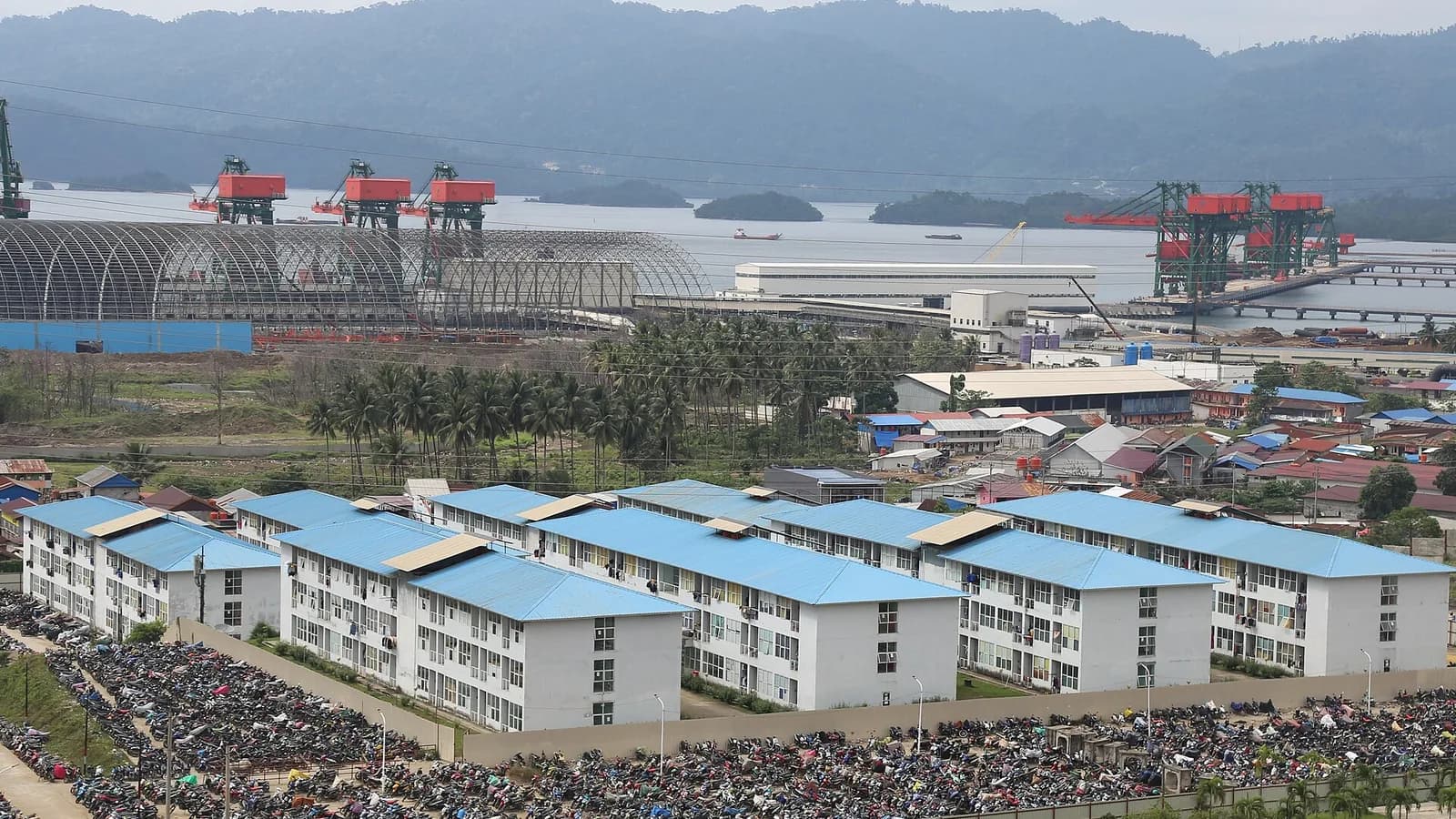
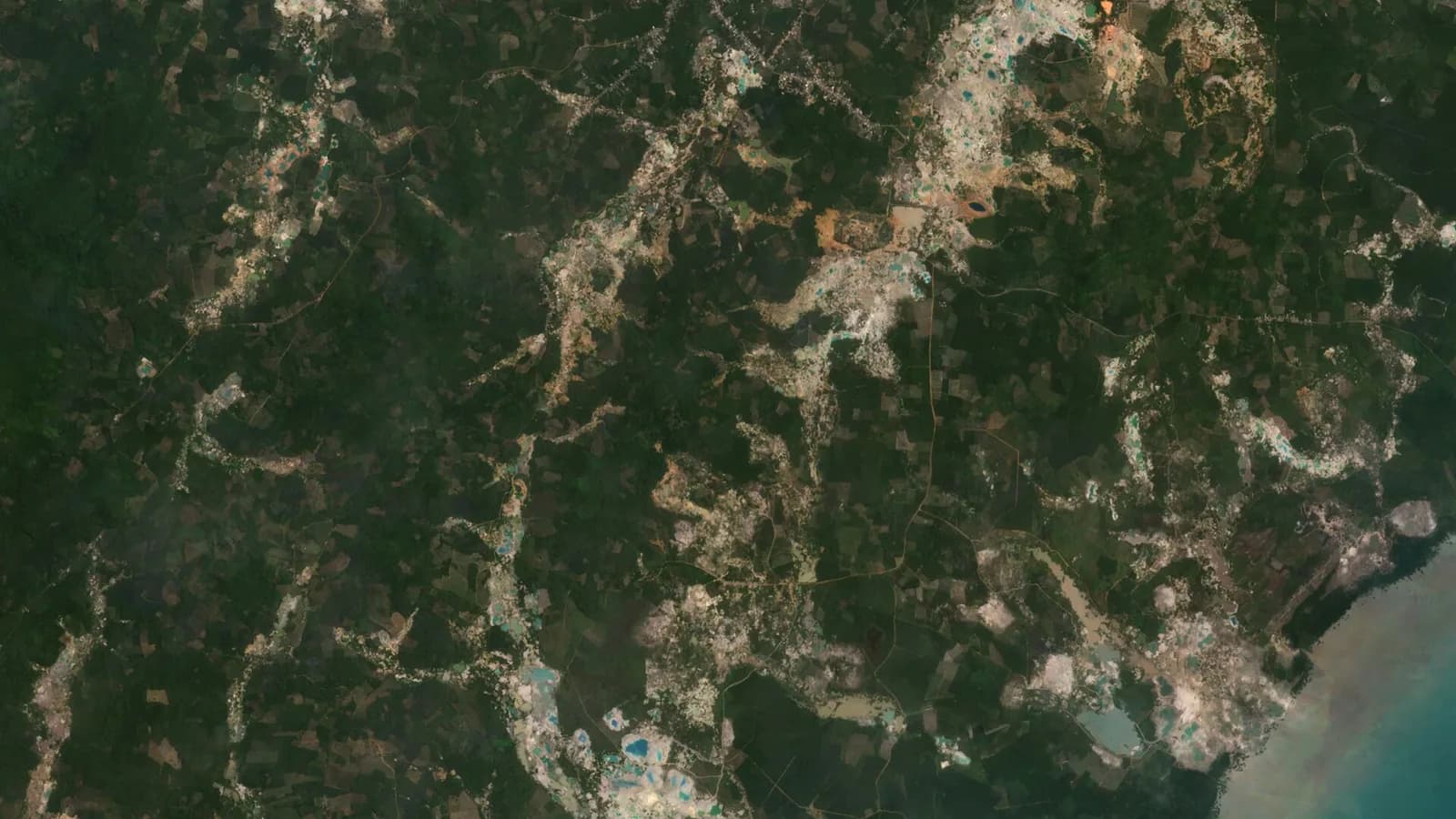
Indonesia's tin is not spread across the archipelago. USGS records that PT Timah, the state producer, mined its 2023 output from three islands — Bangka, Belitung and Kundur — and describes Bangka Belitung Province as the country's "tin mining hub".
The company's own disclosures put the footprint in figures: a mining business permit (IUP) over 473,310 hectares onshore and offshore of Bangka, Belitung and Kundur Island, a head office in Pangkalpinang, Bangka Belitung Province, and operational areas listed as the Bangka Belitung Islands, Riau Province, South Kalimantan and Cilegon in Banten.
That geography explains two features of the sector. Part of the resource is offshore, which is why USGS attributes the 2023 fall in PT Timah's mined output to adverse weather and "deep-seated reserves at offshore mining sites", alongside decreased onshore mining areas and pervasive unauthorized mining on the company's onshore ground. And because production is concentrated in one province, regional conditions — weather, enforcement, the pace of licensing — reach the national figure quickly.
The state producer
PT Timah is the company most foreign readers will meet first, and its role deserves precision.
It is a state-owned enterprise, founded on 2 August 1976 and listed on the Indonesia Stock Exchange since 1995. Its own history traces the lineage further back: Dutch-era mining companies on Bangka, Belitung and Singkep were nationalised between 1953 and 1958, combined in 1968 into PN Tambang Timah, and turned in 1976 into PT Tambang Timah (Persero), fully owned by the government. In 2017 the company's name changed to PT TIMAH Tbk and a 65 percent state shareholding of 4,841,053,951 series B shares moved to PT Indonesia Asahan Aluminium (Persero). The company also describes its heritage as 200 years of tin mining history in Indonesia, which is its own framing rather than a regulator's statement.
Its business, in its own description, is tin ore mining and refined tin production: exploration and exploitation of tin on land and at sea, plus integrated processing and distribution through subsidiaries.
USGS sizes that role. In 2023 PT Timah was the world's fifth-ranked tin refiner and Indonesia's first-ranked tin miner, producing about 14,900 tonnes of mined tin and 15,340 tonnes of refined tin — decreases of 26 percent and 23 percent on 2022. The agency attributes the refined-tin decline to the reduced supply of mined tin, and the mined decline to weather, deep offshore reserves, smaller onshore areas and unauthorized mining.
Set PT Timah's 14,900 tonnes against the national mined figure of 69,000 tonnes for the same year and most of Indonesia's mined tin is not produced by the state company. That arithmetic is ours, not a published breakdown — USGS does not split the national total by producer — but it is the reason the two series should be read separately.
The policy frame around tin
Tin sits inside Indonesia's downstreaming agenda, and the record shows an agenda forming rather than a finished structure.
The chapter for 2022 records that the government "started considering an export ban on unwrought tin" in that year, to attract investment into higher-value products such as tin rod or tin powder, and that the timeline had not been decided. In the past, the same chapter notes, most of Indonesia's unwrought tin had been exported, with China the leading recipient. The Association of Indonesian Tin Exporters asked for gradual implementation, warning that a ban would reduce economic activity in Bangka Belitung and that PT Timah would need more than two years to modify its existing tin chemical plants and secure markets for new products.
The same instrument was applied to a different commodity: the chapter for 2023 records an export ban on bauxite from June 2023, alongside exemptions letting several companies export copper, iron ore, lead-zinc and anode mud through May 2024.
Tin was also classified. In 2023 the Ministry of Energy and Mineral Resources released a list of 47 critical minerals — raw materials used in strategic industries, critical to the national economy, defence and security, prone to supply risk and without a suitable substitute — and tin was on it, alongside aluminium, cobalt, graphite, lithium, nickel, silica and zirconium.
Why it matters beyond Indonesia
For an international buyer, the commercial weight of Indonesian tin is easiest to see from the American side. USGS puts United States net import reliance for refined tin at 77 percent of apparent consumption in 2025, and for the years 2021 to 2024 lists refined tin import sources as Peru 31 percent, Bolivia 27 percent, Indonesia 15 percent, Brazil 10 percent and other 17 percent.
Prices moved with supply over the same stretch: the average London Metal Exchange cash price for refined tin was 1,500 cents per pound in 2025, up 10 percent on 2024, on the same edition's figures.
What an investor should check
- National output is not the state company's output. PT Timah produced roughly a fifth of Indonesia's mined tin in 2023 on the published numbers. A project outside the state company is invisible in the national total, and a national total says nothing about a specific permit.
- Onshore and offshore are different assets. USGS ties the 2023 decline to weather and to deep-seated offshore reserves — risks a buyer of an onshore block does not inherit, and the reverse also holds.
- The reserve figure is recent. The 2025 edition of the summary listed Indonesia's tin reserves as not available; the 2026 edition gives 1.4 million tonnes, revised from company and government reports. A number that new should be checked against a second document before it is modelled.
- The processing question is the live policy question. The unwrought tin export ban was still being considered in the 2022 record, and tin is a listed critical mineral. The direction of policy runs towards domestic processing — confirm the present position with the ministry rather than with a summary.
- Keep every figure beside its edition date. One calendar year of mined tin appears as 70,000 tonnes and then 57,735 tonnes in two consecutive USGS chapters.
Catatan Teramine
This section is Teramine's editorial assessment, not a statement of fact from USGS or any government body.
Indonesian tin has an unusual shape for an investor: a very large published reserve, a production base concentrated on three islands and in one province, a state company that is the world's fifth-ranked refiner but a minority of national mined output, and a policy direction — domestic processing, critical-mineral status — that is stated more clearly than it is scheduled. The honest reading is that the geological position is strong and the operating position is where the questions are: who holds the permit, whether the ground is onshore or offshore, and what the current export and processing rules actually say.
Tin assets currently listed on Teramine are on the [mining marketplace](/en/marketplace). For permit, RKAB and licensing work on an existing Indonesian project, see [mining permit services](/en/layanan-izin). For the licensing backdrop, the explainers on [IUP versus IUPK](/en/news/iup-vs-iupk) and on [what an RKAB is](/en/news/what-is-rkab-indonesia) set out the instruments; for the transaction itself, see [how to buy a mine in Indonesia](/en/news/how-to-buy-a-mine-in-indonesia).
What we could not source, and therefore did not state
Indonesia's unwrought tin export volumes or destinations in any recent year; whether the unwrought tin export ban under consideration in 2022 has since been imposed, and in what form; royalty rates or non-tax state revenue specific to tin; PT Timah's production in 2024 or 2025; the combined output of permit holders other than PT Timah; the number of tin smelters operating in Indonesia; and a current Indonesian tin reserve figure from ESDM itself. None of these appeared in a page opened for this article.
Sources
Every figure, date and quotation above comes from the documents and pages listed below, each of which was opened and read for this article.