Indonesia stopped letting bauxite leave the country as ore on 10 June 2023, and the ban is still standing. In August 2026 the Minister of Energy and Mineral Resources, Bahlil Lahadalia, said the government would maintain its ban on exports of unprocessed mining commodities — bauxite and copper included — and put the reasoning in one line: that as part of transforming the economy, there was no other way but to have domestic industries.
What the ban did to Indonesian bauxite is recorded in official numbers that do not agree with each other. USGS reported Indonesia's 2024 mined bauxite output as 32 million tons in its January 2025 edition, and 9.9 million tons in its February 2026 edition. The same agency, the same year, twelve months apart. Its latest figure for 2025 is an estimated 10 million tons.
For anyone underwriting a bauxite project, a royalty stream or a refinery feedstock contract in Indonesia, that gap matters as much as any single number. This article sets out the regulation as written, the production record edition by edition, the refining capacity built to absorb the ore, and where the investment has gone since the export window closed.
What the regulation actually says
The ban is not a prohibition clause. It is a date.
Peraturan Menteri ESDM No. 17 Tahun 2020, the third amendment to the ministry's regulation on mineral and coal mining business (*Pengusahaan Pertambangan Mineral dan Batubara*), was signed on 11 November 2020 and promulgated on 23 November 2020.
Article 46(1) permitted a production-operation IUP holder to sell washed bauxite with an Al₂O₃ content of at least 42 percent abroad "paling lama sampai dengan tanggal 10 Juni 2023" — no later than 10 June 2023. Article 46(2) attached two conditions to any sale inside that window: the holder had to have built, or be building, a refining facility, and had to pay the export duty. Article 46(3) allowed the refining requirement to be met either by building the plant or by holding shares directly in the refinery company.
The same date governed the rest of the mineral sector. Article 44 allowed metal-mineral permit holders to sell processing output abroad until 10 June 2023, subject to the same refinery and duty conditions. Article 47 repeated the deadline. Article 51 allowed the export recommendation only where the physical progress of refinery construction matched the independently verified plan, "paling lambat pada tanggal 10 Juni 2023". The regulation's own recital states the purpose: to guarantee the construction of domestic refining facilities, implementing Article 170A(3) of Law No. 3 of 2020.
| Date | What happened |
|---|---|
| 11–23 November 2020 | Permen ESDM No. 17/2020 signed and promulgated, fixing 10 June 2023 as the last date for washed bauxite exports |
| July 2021 (June 2021 data) | ESDM records two alumina refineries operating and twelve under construction |
| 10 June 2023 | The export window closes |
| 2023 | A China-based aluminium producer acquires an Indonesia-based miner holding rights to three bauxite mines in Kalimantan [USGS] |
| 24 September 2024 | President Joko Widodo inaugurates the first bauxite injection at the Mempawah smelter-grade alumina refinery in West Kalimantan |
| April 2025 | The 1-million-ton-per-year Mempawah refinery ships its first alumina, to an aluminium smelter in North Sumatra [USGS] |
| April–May 2025 | ESDM tells a DPR commission there are 14 integrated mineral smelter projects worth US$8.69 billion; industry associations say bauxite smelter projects are stalled on financing |
| 7–10 August 2026 | The mining minister says the ban stays; bauxite is reported as the largest recipient of downstreaming investment in the second quarter |
The production record, edition by edition
USGS publishes the world bauxite and alumina table every year, and the Indonesian line has moved in both directions.
| USGS edition | Alumina output | Bauxite output | Bauxite reserves |
|---|---|---|---|
| Mineral Commodity Summaries 2024 (January 2024) | 1.2 Mt (2022); 1.2 Mt (2023 est.) | 21 Mt (2022); 20 Mt (2023 est.) | 1,000 million tons |
| Mineral Commodity Summaries 2025 (January 2025) | 1.2 Mt (2023); 1.3 Mt (2024 est.) | 30 Mt (2023); 32 Mt (2024 est.) | 2,800 million tons |
| Mineral Commodity Summaries 2026 (February 2026) | 1.2 Mt (2024); 1.5 Mt (2025 est.) | 9.9 Mt (2024 est.); 10 Mt (2025 est.) | 2,900 million tons |
Two sentences in the latest edition frame the movement. On the world table, USGS states that "significant revisions were made to the 2024 production of alumina for Germany and of bauxite for Greece and Indonesia based on company and Government reports", and that reserves for Australia, Brazil, China, Indonesia, Kazakhstan and Russia were revised on the same basis. In its events section, the same edition records that bauxite production "declined sharply following Indonesia's 2023 ban on bauxite exports", and that the Mempawah refinery's additional capacity "may support an increase in bauxite production".
On the 2026 estimates, an output of 10 million tons places Indonesia sixth among the countries USGS lists individually, behind Guinea (150 Mt), Australia (97 Mt), China (87 Mt), Brazil (33 Mt) and India (25 Mt) — and against a world total of 440 million tons.
Two further figures set the pre-ban baseline, both from ESDM. The ministry's Grand Strategy Mineral dan Batubara, published in July 2021, records that in 2020 Indonesia produced 26.3 million tons of bauxite ore while domestic uptake was about 1.71 million tons, and puts Indonesian bauxite resources at 5.5 billion tons with reserves of 3 billion tons. In May 2025, the chairman of the Indonesian Bauxite Association (ABI), Ronald Sulistyanto, said miners were able to produce up to 30 million tons a year while domestic processing and refining input capacity remained limited, and argued that reopening washed bauxite exports would let companies rebuild equity.
The refining capacity the ban was built around
ESDM's 2021 Grand Strategy gives the starting position, based on June 2021 data. Two alumina refineries were operating: PT Well Harvest Winning Alumina Refinery, with realised production of 1 million tons of smelter-grade alumina in 2020, and PT Indonesia Chemical Alumina, with 93 thousand tons of chemical-grade alumina in the same year. Their combined bauxite input capacity was 4,564,000 tons a year. Twelve further refineries were in construction, with combined bauxite input capacity of more than 35 million tons a year.
USGS then records two completions. In its 2025 edition, "an Indonesia-based mining company began production at its 2.2-million-ton-per-year alumina refinery in the Province of West Kalimantan" (2024 events; the edition does not name the company). In its 2026 edition, in April the 1-million-ton-per-year refinery at Mempawah shipped its first alumina to an aluminium smelter in North Sumatra.
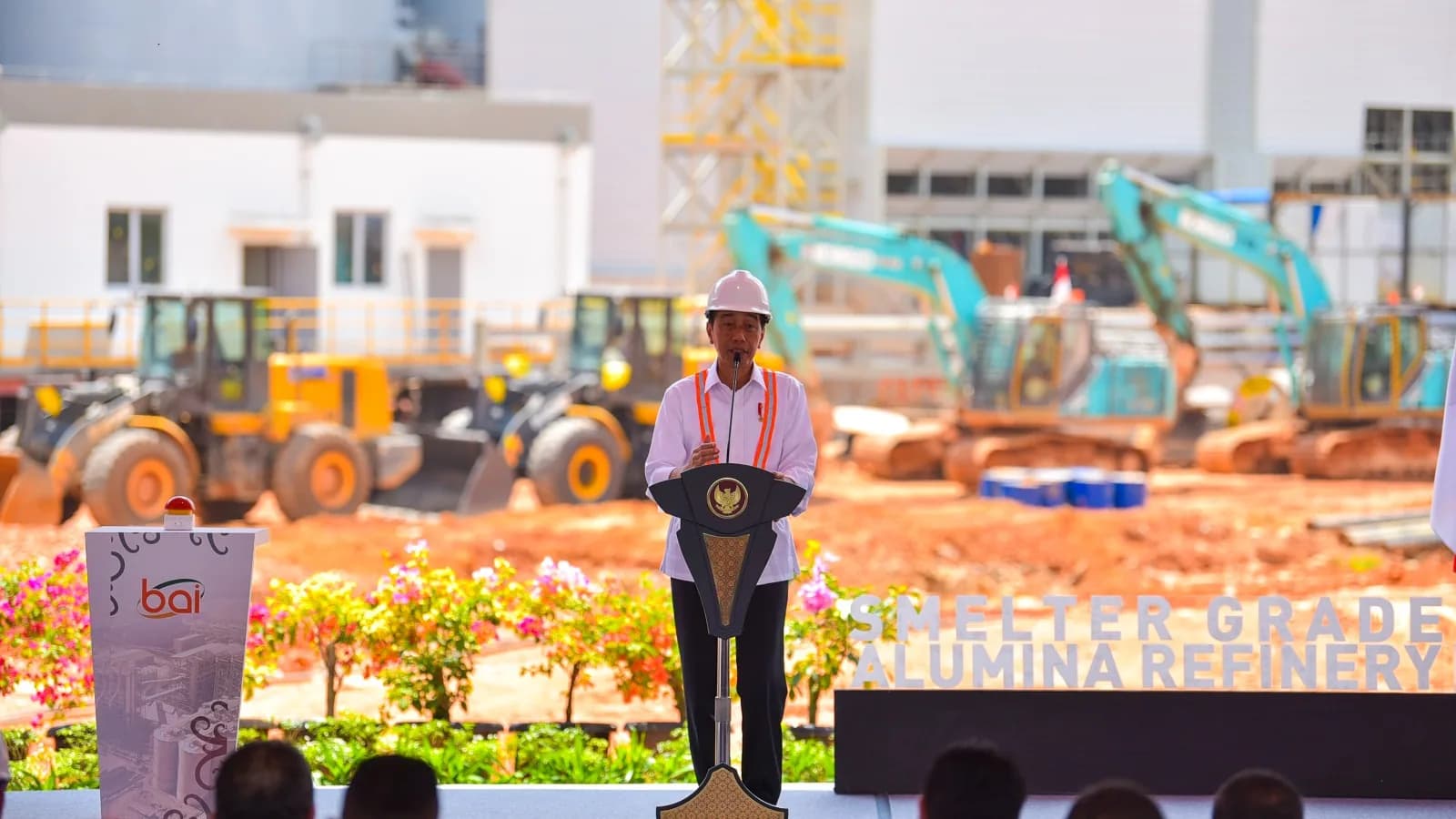
The Mempawah asset is the one with the most public detail. Reuters reported on 24 September 2024 that President Joko Widodo had launched a US$941 million smelter-grade alumina refinery run by state miner Aneka Tambang (Antam) and state-owned aluminium producer Inalum in West Kalimantan, with a capacity of 1 million tons of alumina a year, absorbing 3.3 million tons of bauxite input.
"The domestic aluminium demand is 1.2 million tons, 56% is imported while we have the raw material. When these are all completed, we can stop the import." — President Joko Widodo, as reported by Reuters, 24 September 2024
Reuters also reported that the companies planned to expand capacity by another 1 million tons and to build an aluminium plant, citing MIND ID chief executive Hendi Prio Santoso: a second phase that may cost around another US$900 million, and a future aluminium plant estimated at US$2 billion.
MIND ID's own release, a year earlier, describes the same project with different figures and dates, and we give them as published rather than reconciling them. In a statement dated 11 September 2023, the holding company said the SGAR Phase I project at Mempawah, built through PT INALUM, had begun in 2019 with completion originally planned for 2023, was then targeted for the second half of 2024, with commercial operation effectively from 2025. It described the project as US$830 million. The alumina would feed INALUM's Kuala Tanjung smelter, which the release gives as 1 million kilotons a year of alumina — enough, it said, for 500 thousand tons of aluminium. The project company, PT Borneo Alumina Indonesia, is 60 percent INALUM and 40 percent Antam, and a Phase II was planned with the potential addition of 2 million tons of alumina capacity, for which a strategic partner was being sought.
Where the two sources differ on cost — US$830 million in MIND ID's own words in September 2023 against US$941 million in Reuters' report a year later — we record both and reconcile neither.
Where the bauxite is
ESDM's 2021 Grand Strategy records 99 active bauxite permits covering about 858 thousand hectares, spread across the Riau Islands, West Kalimantan and Central Kalimantan, and describes crude bauxite as requiring washing before it can be processed further. USGS's 2024 edition records that in 2023 a China-based aluminium producer acquired an Indonesia-based miner with mining rights to three bauxite mines in the Kalimantan province of Indonesia, one of which it said had estimated bauxite reserves of 68 million tons.
Where the money went instead
Indonesia Business Post, reporting on 10 August 2026, put bauxite downstreaming investment at Rp40.1 trillion (US$2.26 billion) in the second quarter of 2026, up 193 percent from Rp13.7 trillion (US$773 million) in the first quarter, making bauxite the largest recipient of downstreaming investment in the period and displacing nickel (Rp29.4 trillion, US$1.66 billion), ahead of copper (Rp16.7 trillion, US$941 million), iron and steel (Rp13.2 trillion, US$745 million) and silica sand (Rp4 trillion, US$226 million).
"Usually, nickel is always number one. Now there is a shift, with bauxite becoming number one because several bauxite projects are being developed by both domestic and foreign investors." — Investment and Downstreaming Minister Rosan Roeslani, quoted by Antara on 7 August 2026 and reported by Indonesia Business Post
The same reporting carries the mining minister's statement that the ban on unprocessed exports would be maintained, and the national context: downstreaming investment of Rp152.7 trillion (US$8.62 billion) in the second quarter of 2026, up 5.7 percent year on year and 29.8 percent of national investment realisation of Rp511.8 trillion (US$28.89 billion).
Against that, the friction is documented too. Bloomberg Technoz's account, republished by the mining professionals' association PERHAPI on 8 May 2025, records that ABI's Ronald Sulistyanto put the investment cost of a bauxite smelter at US$1.2 billion for 2 million tons, said progress on the stalled projects averaged below 50 percent, and pointed to banks and investors treating bauxite downstreaming as insufficiently profitable. PERHAPI's chairman, Sudirman Widhy Hartono, asked the government to help find solutions for bauxite smelter projects that had stopped, mainly over funding. The same piece reports ESDM's Director General of Minerals and Coal, Tri Winarno, telling a DPR commission that Indonesia had 14 integrated mineral smelter projects with total investment of US$8.69 billion, of which six bauxite projects were ongoing at US$2.18 billion, alongside five integrated nickel projects (one ongoing, four existing) at US$2.54 billion, two existing copper smelters at US$3.92 billion and one iron project at US$46.6 million.
What an investor should check
- The feedstock can move only domestically. With the export route closed, a mine without a domestic buyer or an associated refinery has no legal sales channel for ore. That is the condition the regulation was written to create.
- The refinery is part of the permit logic, not a separate project. Article 46(2) and 46(3) tie the right to sell abroad to having built — or being a shareholder in — a refining facility, and Article 51 ties the ministry's recommendation to independently verified construction progress.
- Treat any single production figure as provisional. The same calendar year was reported by USGS as 32 million tons and then 9.9 million tons. A model that leans on one edition inherits that error.
- Timeline risk is documented, not hypothetical. Refinery construction at Mempawah ran from a 2019 start to a 24 September 2024 inauguration and a first alumina shipment in April 2025; ABI described average progress on stalled bauxite smelter projects as below 50 percent in May 2025.
- Reserve figures differ with vintage and author. USGS put Indonesian bauxite reserves at 1 billion tons in January 2024, 2.8 billion tons in January 2025 and 2.9 billion tons in February 2026, while ESDM's 2021 Grand Strategy recorded 3 billion tons for 2020. Read the date before the number.
- Use the conversion rule of thumb. USGS states that, as a general rule, 4 tons of dried bauxite produces 2 tons of alumina, which in turn can produce 1 ton of aluminium. Reuters reported the Mempawah design as 3.3 million tons of bauxite input for 1 million tons of alumina output.
Catatan Teramine
This section is Teramine's editorial assessment. It is not a statement from USGS, ESDM or any company, and it is not a quotation from any source.
The published record cannot tell you when Indonesian bauxite output fell, or by how much. That is the single most important thing in this article. USGS revised Indonesia's 2023 figure up from an estimated 20 million tons to 30 million tons between its 2024 and 2025 editions, then revised the 2024 figure down from 32 million tons to 9.9 million tons between its 2025 and 2026 editions — and only the later edition contains the statement that production "declined sharply" after the ban. The most economical reading is that the 2025 edition carried export-era expectations that its successor corrected against company and government reports, but that is our reading, not something either document says. What can be said without interpretation is that the direction is negative in the latest edition and that the size of the fall is not established by these documents.
The live constraint is capital, not legality. The ban has been in force since June 2023 and has not been reversed, and the government has kept saying it will not be. But the association representing the miners described the obstacle as funding and bankability — a bauxite smelter at roughly US$1.2 billion per 2 million tons of capacity — rather than a legal one, and asked for the government to take equity or for the export window to reopen. That is a request about equity, which tells you where the binding constraint sits. Investors arriving now should read the export ban as settled and the smelter economics as unresolved.
Watch the difference between investment announcements and input capacity. Bauxite has just become the largest named destination for downstreaming investment in a single quarter, and that is a real signal about where capital is going. It is not the same as tonnage of bauxite actually consumed in Indonesia. The one capacity number in this article that is stated in input terms — 4.56 million tons a year from two refineries and more than 35 million tons a year from twelve under construction, as of June 2021 — is five years old, and no source we read gives the current figure. An investor needs the current input capacity, refinery by refinery, before the investment headline becomes useful.
What we could not source, and therefore did not state: Indonesia's bauxite export volumes before or after June 2023; the mineral benchmark price (HPM) or royalty rate applicable to bauxite; the number of alumina refineries operating in 2026 and their combined bauxite input capacity; whether any permit holder has received an exemption from the export rule; the identity of the 2.2-million-ton-per-year West Kalimantan refinery in USGS's 2025 event list; the exact date of the DPR commission meeting at which ESDM gave the US$8.69 billion figure; and any single 2026 figure for Indonesian bauxite reserves published by ESDM itself.
Where the question is transactional, Indonesian mining assets are listed on the [mining marketplace](/en/marketplace). Where it is about a permit you already hold, that work sits with our [permit services](/en/layanan-izin). The nickel precedent behind this policy is set out in [Indonesian nickel mining investment](/en/news/indonesia-nickel-mining-investment-2026), the licence types that carry the refinery obligation in [IUP vs IUPK](/en/news/iup-vs-iupk), and the state holding behind Mempawah in our overview of [Indonesian mining companies](/en/news/indonesia-mining-companies).
Sources
Every figure, date, clause and quotation in this article comes from the documents and pages below, each of which was opened and read for it. Where two editions of the same series disagree, both are shown with their edition.